
Contents
Ferrite Magnet Selection: A Technical Application Guide
- Lucian.P
- Product Guide

Introduction
Core Technical Parameters Defining Ferrite Magnet Performance

Remanence (Br)
- Ferrite magnet Br range: 0.2 T (low-grade) – 0.52 T (high-grade)
- Standard commercial grades (Y30, Y35) Br range: 0.38 T – 0.48 T
- A higher Br value delivers stronger magnetic force, critical for cost-sensitive designs requiring consistent output (e.g., consumer electronics micro-motors, industrial actuators).
- Key advantage: Ferrite magnets maintain stable Br values across moderate temperature ranges, unlike rare-earth magnets, making them ideal for applications with consistent operating conditions.
Coercivity (HcB & HcJ)
- HcJ is the critical metric for temperature stability (far more important than HcB for real-world applications)
- Ferrite magnet HcJ range: 120 kA/m – 300 kA/m
- High-coercivity grades (Y30BH, Y35BH) are engineered for elevated temperature environments, enabling reliable performance in industrial automation equipment and automotive components under continuous thermal stress with no permanent performance loss.
Maximum Energy Product ((BH)max)
- HcJ is the critical metric for temperature stability (far more important than HcB for real-world applications)
- Ferrite magnet HcJ range: 120 kA/m – 300 kA/m
- High-coercivity grades (Y30BH, Y35BH) are engineered for elevated temperature environments, enabling reliable performance in industrial automation equipment and automotive components under continuous thermal stress with no permanent performance loss.
Curie Temperature (Tc)
- Ferrite magnet Tc range: 450°C – 550°C (a significant advantage over neodymium magnets, which have a Tc of ~310°C)
- This high Tc makes ferrite magnets ideal for high-heat applications where other magnet types would fail (e.g., industrial furnace sensors, automotive engine bay components).
Maximum Operating Temperature (Tmax)
- Standard ferrite magnet Tmax: 120°C
- High-temperature grades (Y30BH, Y40BH) Tmax: 150°C – 180°C
- Tmax differentiates ferrite grades for specific thermal environments and is the primary temperature consideration for application-specific selection (not Tc).
Application-Specific Ferrite Magnet Selection Criteria

Industrial Automation
- High intrinsic coercivity: HcJ ≥ 150 kA/m
- Medium maximum energy product: 25 kJ/m³ – 30 kJ/m³
- Recommended grades: Y35, Y35BH
- Inherent corrosion resistance eliminates the need for additional coatings (reduces production costs and simplifies integration)
- Dimensional tolerance requirement: ±0.03mm (for motor rotor/stator magnets to ensure proper alignment, minimize energy loss, and extend service life)
Consumer Electronics
- Balanced remanence: 0.40 T – 0.45 T
- Medium-low maximum energy product: 20 kJ/m³ – 25 kJ/m³
- Recommended grades: Y30, Y32
- Non-toxic, eco-friendly composition aligns with global consumer electronics regulatory standards
- Inherent corrosion resistance eliminates the need for thin coatings, enabling tight dimensional tolerances
- Dimensional tolerance requirement: ±0.02mm (for compact components like speaker magnets and micro-sensors)
Aerospace & UAV
- Ultra-high intrinsic coercivity: HcJ ≥ 200 kA/m
- Medium-to-high maximum energy product: 30 kJ/m³ – 35 kJ/m³
- Recommended grades: Y35BH, Y40BH
- Maintains magnetic stability across extreme thermal ranges, offering a cost-effective, lightweight alternative to rare-earth magnets for non-critical aerospace components
- Inherent corrosion resistance eliminates coating needs (critical for high-altitude and marine UAV operations)
- Dimensional tolerance requirement: ±0.01mm (for precision sensors to ensure accurate performance in critical systems)
Practical Integration Considerations for Ferrite Magnet Selection

Coating and Corrosion Protection
- Exception scenarios requiring coating: Extreme environments such as saltwater exposure (UAVs operating over oceans), harsh chemical exposure (industrial chemical processing equipment), or prolonged high-humidity conditions.
- Recommended coating for extreme environments: Thin epoxy coating (adds minimal weight and maintains dimensional precision while enhancing durability).
Custom Machining and Form Factor
- Key machining consideration: Ferrite is a brittle material, requiring specialized diamond cutting and grinding techniques to avoid chipping, cracking, or structural damage during production.
- Critical selection tip: Partner with a magnet manufacturer with in-house advanced CNC machining capabilities—this ensures dimensional accuracy, structural integrity, and eliminates the need for third-party processing (reduces lead times and quality control risks).
- Custom form factors enable seamless integration into existing product designs, eliminating the need for costly system modifications.
Cost-Performance Balance
- Cost variance: High-temperature ferrite grades (e.g., Y35BH) cost 15–20% more than standard grades (e.g., Y30).
- Avoid over-specification: Using a high-temperature grade (e.g., Y40) for a low-heat application (e.g., a household refrigerator motor) leads to unnecessary cost escalation with no performance benefit.
- Avoid under-specification: Using a low-grade ferrite (e.g., Y25) for a high-temperature industrial motor leads to premature demagnetization and equipment failure.
- Optimal strategy: Match the ferrite grade to the minimum performance requirements of the application—this leverages ferrite’s cost-effectiveness to maximize overall value.
Supply Chain and Quality Consistency
- Key supplier selection criteria: A manufacturer with a strict ISO 9001-certified quality control system and in-house testing of all core technical parameters (Br, HcJ, (BH)max) for every production batch.
- Supply chain advantage: Ferrite’s simple, eco-friendly manufacturing process uses widely available raw materials, ensuring stable supply chains with minimal risk of raw material shortages (a critical benefit over rare-earth magnets, which rely on limited mineral resources).
Tailored Ferrite Magnet Solutions for Targeted Applications

- Precise grade selection matched to thermal and magnetic performance requirements
- Custom form factors and dimensional tolerances tailored to system integration
- Minimal, application-specific coating (only for extreme environments)
- Consistent batch-to-batch quality for high-volume production
- Scalable manufacturing capabilities to meet production demand
Key Takeaways for Optimal Ferrite Magnet Selection
Core Selection Principles to Remember
- Prioritize intrinsic coercivity (HcJ) over all other parameters for high-temperature applications—it is the single most critical metric for ferrite magnet stability under thermal stress.
- Match grade to minimum performance requirements: Ferrite’s greatest strength is cost-effectiveness, and over-specification leads to unnecessary production costs with no tangible benefit.
- Leverage inherent corrosion resistance: Eliminate unnecessary coatings for standard applications to reduce costs and streamline production—only coat for extreme saltwater/chemical/humidity environments.
- Prioritize dimensional precision: Even small deviations (0.01mm–0.03mm) can impact system integration and performance; partner with a manufacturer with in-house precision machining capabilities.
- Validate quality consistency: For high-volume production, ensure your supplier has a strict quality control system and in-house testing for all core technical parameters to avoid batch-to-batch variability.
Some FAQs
How do I select the right ferrite magnet grade based on my application’s magnetic strength and temperature requirements?
It depends on your application’s magnetic output needs and operating temperature: choose high-grade ferrite (Y35–Y40) for stronger magnetic force in compact designs; high-coercivity grades (Y30BH–Y40BH) for elevated temperature environments (up to 180°C); standard grades (Y25–Y32) for cost-sensitive, moderate-performance applications like consumer electronics.
Which ferrite magnet grade is optimal for industrial automation motors operating under continuous thermal stress?
For industrial automation motors, prioritize ferrite grades with high intrinsic coercivity (HcJ ≥ 150 kA/m) and medium (BH)max (25–30 kJ/m³), such as Y35 or Y35BH. These grades resist demagnetization from thermal and magnetic stress, while ferrite’s inherent corrosion resistance eliminates the need for additional coatings in most industrial environments.
Do ferrite magnets require surface treatment or coatings, and when should I consider them?
Ferrite magnets are inherently corrosion-resistant due to their iron oxide composition, so coatings are unnecessary for most standard applications (e.g., consumer electronics, industrial sensors). However, in extreme environments like saltwater exposure (UAVs) or harsh chemical settings, a thin epoxy coating can be applied to enhance durability and extend service life.
What custom shapes are available for ferrite magnets, and what considerations are critical for custom machining?
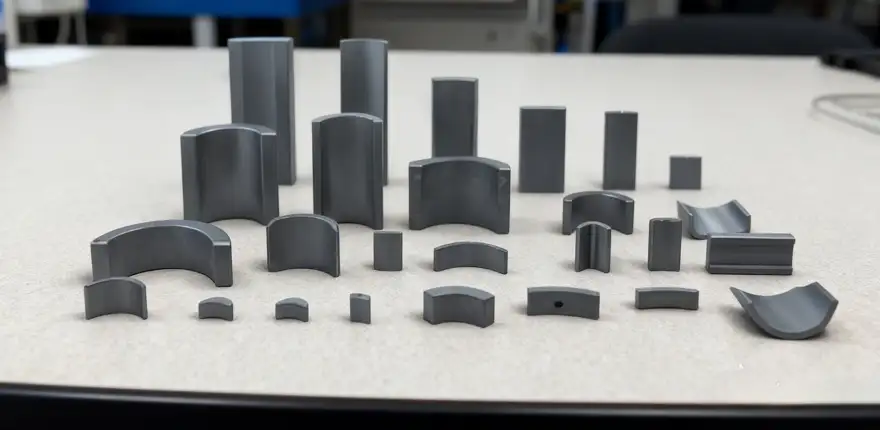
Ferrite magnets can be custom-machined into arcs, stepped shapes, countersunk forms, and other non-standard designs for motor rotors, sensors, and actuators. Key considerations include ferrite’s brittle nature—requiring specialized diamond cutting and grinding to avoid chipping—and tight dimensional tolerances (±0.01mm for aerospace applications) to ensure proper system integration.
Why is it important to test ferrite magnet samples before full-scale production?
Testing samples ensures that the selected ferrite grade, shape, and coating meet your application’s performance, temperature, and durability requirements. It also validates batch-to-batch consistency, which is critical for high-volume production to avoid end-product variability and premature failure.

Lucian.P
Hi, I’m a technical expert at TOPMAG (10+ years in the permanent magnet industry) and author of this blog.
I’m dedicated to popularizing magnet-related content—covering principles, applications, industry anecdotes, and key tips to avoid selection pitfalls. My core goal is to provide valuable information that helps readers understand the charm and practical significance of magnets.
Two key industry trends to note: ① The new energy sector drives surging demand for high-energy/high-temperature-resistant magnets; ② Custom solutions have become the mainstream choice.
Follow this blog and feel free to share your magnet-related needs, questions, or ideas via comments, email, or WhatsApp. Let’s explore the endless possibilities of magnets together!
