
Contents
HRE-Free NdFeB Magnets: A Cost-Effective Solution for High-Performance Applications
- Lucian.P
- Knowledge base
Introduction
NdFeB magnets are widely recognized as one of the highest-performance permanent magnet materials due to their excellent magnetic energy product. However, traditional high-performance NdFeB magnets rely on heavy rare earth elements to improve coercivity and resistance to demagnetization at high temperatures.
Heavy rare earth elements have limited resources and high costs. Dependence on heavy rare earth materials not only increases magnet costs but also brings certain supply chain risks. To reduce dependence on heavy rare earth elements, HRE-Free NdFeB magnets have emerged as one of the most promising development directions in the magnetic materials industry.
What Are HRE-Free NdFeB Magnets?

HRE-Free NdFeB magnets refer to neodymium iron boron permanent magnets that contain no or extremely small amounts of heavy rare earth elements, such as dysprosium (Dy) and terbium (Tb).
Traditionally, to maintain stable magnetic performance in high-temperature environments (such as above 150°C), heavy rare earth elements are usually added to enhance grain boundary anisotropy.
HRE-Free NdFeB magnets mainly improve magnetic performance through technologies such as grain boundary optimization, grain refinement, and composition adjustment, reducing dependence on heavy rare earth elements while maintaining high magnetic performance.
Why Reduce Heavy Rare Earth Elements?

Reduce Material Cost
Reducing heavy rare earth content helps achieve better cost control and reduces the impact of rare earth price fluctuations. This is especially important for industries that require large quantities of permanent magnets.
Improve Supply Chain Stability
Heavy rare earth resources are highly concentrated globally, making the supply chain vulnerable to international trade policies and geopolitical changes.
Promote Green Magnetic Material Development
Traditional heavy rare earth mining and extraction processes may create significant environmental costs and ecological impacts. HRE-Free technology is more aligned with global carbon neutrality and green manufacturing goals.
Differences Between HRE-Free NdFeB Magnets and Traditional NdFeB Magnets
Different types of NdFeB magnets have differences in material design, performance focus, and application positioning. The following comparison shows the main differences between heavy rare earth-containing NdFeB magnets and HRE-Free NdFeB magnets.
| Comparison Item | Heavy Rare Earth NdFeB | HRE-Free NdFeB |
|---|---|---|
| Heavy rare earth elements | Added Dy/Tb to improve high-temperature performance | Reduced or no Dy/Tb usage |
| Cost | Higher cost, affected by HRE price fluctuations | More cost-effective |
| High-temperature performance | Significant advantages in extreme environments | Improved stability through material optimization |
| Technology approach | Heavy rare earth enhancement | Grain boundary optimization and structural control |
| Application focus | High-temperature and high-reliability applications | Balanced performance and cost applications |
HRE-Free NdFeB Magnet Grades and Performance

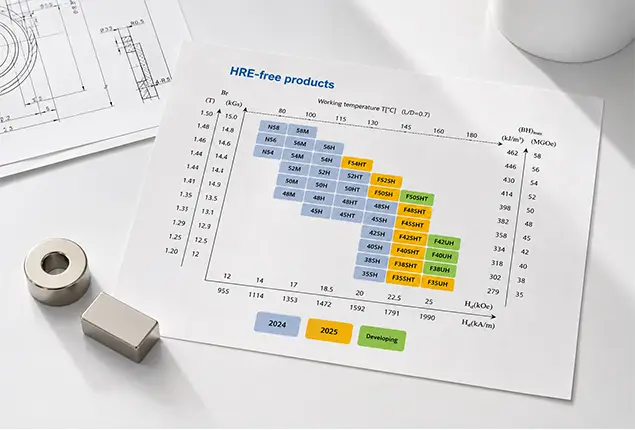
TOPMAG provides multiple HRE-Free NdFeB magnet grades. Through grain boundary optimization technology and manufacturing process improvements, TOPMAG reduces heavy rare earth usage and provides cost-effective HRE-Free magnet solutions.
Currently, our product system includes HRE-Free series and F HRE-Free series, including:
- H series products have achieved mass production, with Hcj > 1353 kA/m
- SH series products have achieved mass production, with Hcj > 1592 kA/m
- SHT series products can be produced through the F process, with Hcj > 1790 kA/m
TOPMAG HRE-Free NdFeB magnets cover multiple performance grades to meet different application requirements for magnetic performance, demagnetization resistance, and cost control. Click to view HRE-Free NdFeB Magnet Performance Data for detailed parameters.
Applications of HRE-Free NdFeB Magnets

With technological advancements, HRE-Free NdFeB magnets have been applied in various high-performance industrial and consumer fields:
- Electric Vehicles (EV): Widely used in drive motors, meeting daily and medium-temperature operating conditions while effectively reducing vehicle manufacturing costs.
- Wind Power: Used in direct-drive permanent magnet wind generators to reduce the overall construction cost of large-scale equipment.
- Industrial Automation: Used in robots, automation equipment, and high-efficiency motion control components in smart manufacturing systems.
- Smart Appliances: Can be applied in high-efficiency compressors, fans, and other precision magnetic components.
Limitations of HRE-Free NdFeB Magnets
Although HRE-Free NdFeB magnets offer many advantages, they are not suitable for all application environments. In the following cases, heavy rare earth NdFeB grades may still be required:
- Extremely high-temperature environments
- Strong demagnetizing magnetic fields
- Applications requiring extremely high coercivity
Conclusion
HRE-Free NdFeB magnets represent an important milestone in the transition of permanent magnet materials from resource-dependent solutions to technology-driven solutions.
They provide companies with a solution that balances high performance and cost efficiency while supporting sustainable development.
Although HRE-Free NdFeB magnets cannot completely replace all NdFeB grades designed for high-temperature and extreme-performance requirements, their application range continues to expand with ongoing advancements in material technology.
Some FAQs
Is HRE-Free magnet performance lower than traditional NdFeB magnets?
Not necessarily. HRE-Free magnets improve performance through grain boundary optimization and advanced manufacturing technologies. Actual performance depends on the specific grade and application requirements.
Can HRE-Free magnets completely replace traditional magnets?
No. HRE-Free magnets are suitable for many cost-effective applications, but traditional high-temperature grades may still be required for extreme high-temperature or high demagnetization environments.
Can HRE-Free NdFeB magnets be customized?
Yes. HRE-Free NdFeB magnets can be customized according to customer requirements, including magnetic grades, dimensions, magnetization directions, surface treatments, and application solutions.
Can HRE-Free NdFeB magnets be exported?
Yes. Since HRE-Free NdFeB magnets reduce or eliminate the use of heavy rare earth elements such as Dy and Tb, they may offer advantages in certain supply chain and export scenarios. Specific export requirements should be confirmed based on product specifications and target market regulations.
Do HRE-Free NdFeB magnets require special storage conditions?
No special storage conditions are required. They should be stored in a dry, room-temperature environment, avoiding moisture, high temperatures, strong impact, and surface damage.
For more insights, check these related blogs:
NdFeB Magnet Grades Explained: A Complete Selection Guide
Magnetic Remanence Stability: Technical Principles & Applications
Ferrite Magnet Selection: A Technical Application Guide
Neodymium Magnet Selection Guide: How to Choose the Right Permanent Magnet for Your Application
Ready to upgrade your project? Browse our full product line at TOPMAG!🧲

Lucian.P
Hi, I’m a technical expert at TOPMAG (10+ years in the permanent magnet industry) and author of this blog.
I’m dedicated to popularizing magnet-related content—covering principles, applications, industry anecdotes, and key tips to avoid selection pitfalls. My core goal is to provide valuable information that helps readers understand the charm and practical significance of magnets.
Two key industry trends to note: ① The new energy sector drives surging demand for high-energy/high-temperature-resistant magnets; ② Custom solutions have become the mainstream choice.
Follow this blog and feel free to share your magnet-related needs, questions, or ideas via comments, email, or WhatsApp. Let’s explore the endless possibilities of magnets together!
